
Trade or LLC in 2025?

In 2025, one of the most common business dilemmas is the question of whether to do business in the form of trades (as a natural person) or establish a limited liability company (Ltd.). The answer is not universal: it depends on your specific situation, planned business scope, expected income, or personal preferences. In the following article, you will find a comprehensive comparison of both options that can help you make the right decision.
Speed of starting a business and entry costs
Trade
- You can start a business practically overnight. Just fill out a simple form at the trade license office (or electronically via www.slovensko.sk) and pay small fees:
- 7 € for each free trade (€0 for electronic filing),
- 22 € for each craft or related trade (€11 for electronic submission).
- After registration, you can start doing business immediately (you need to have the documents in order and the fees paid).
Ltd.
- Setting up takes longer and is more administratively demanding. You need:
- Prepare a memorandum of association or articles of association.
- Repay contributions to the share capital.
- Obtain a business license (often a trade license).
- Submit a proposal to register the company in the Commercial Register.
- The fee for registering an LLC in the Commercial Register is 220 €.
- You can only do business once the company is registered in the Commercial Register.
Scope of liability for obligations
Trade
- A sole proprietor (natural person) is liable for business obligations with all his possessions – including personal ones that are not used for business.
- If someone asserts a claim against you (e.g. an unpaid invoice or damage caused), in extreme cases, the bailiff can seize your family car or house.
Ltd.
- The company is liable for its obligations with all its assets, but a partner is only liable up to the amount of the unpaid contribution (usually the contribution is fully paid).
- As partners, you usually do not bear any direct risk.
- However, if you are also an executive, you may be at risk personal liability for damage caused to the company or creditors (Section 135a(5) of the Commercial Code). However, you can escape this liability if you prove that you acted with professional care.
Options for withdrawing money from a business
Trade
- The money you earn belongs directly to you. As a sole proprietor, when the funds arrive in your account, you can immediately dispose of them.
- There is no separate "business" and "private" entity - you are still the same individual.
Ltd.
- Ltd. is a separate legal entity – the money belongs to the company first, not to you.
- If you want to get them, you have to get them from the company in some legal way. to pay out (employee salary, executive compensation, dividend, invoicing for services, etc.).
- Each of these forms has a different tax burden.
Income tax in 2025
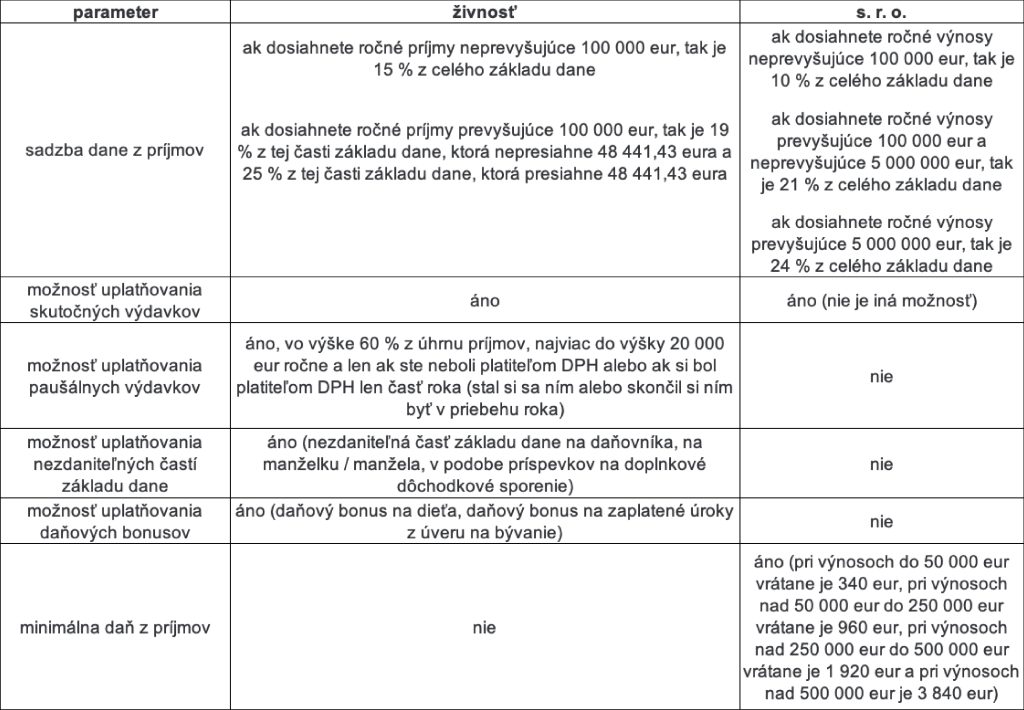
In addition, it should be taken into account that dividends (shares in profits) are taxed at a rate of 7 %, and no contributions are paid on them. On the other hand, you can only access dividends after the end of the year. There is no clear comparison of which is more advantageous. With smaller incomes and minimal real expenses, flat-rate expenses of a sole proprietorship can help. With larger amounts, optimization options in an LLC (especially dividends) can be interesting. However, the decision should be supported by specific figures - detailed calculation can reveal which form is more tax-efficient for you.
Social and health contributions
Trade
- Social insurance only starts to be paid when your income exceeds a certain threshold (for 2025, income for 2024 is monitored, the threshold is €8,580). The amount of the monthly premium is calculated from the assessment base, which is determined as follows: (tax base on income from trade + contributions paid from trade) / 1.486 / 12. The result is rounded down to two decimal places. Social insurance is a total of 33.15 % of this assessment base. However, it is established also the minimum assessment base and the minimum social insurance calculated from it.
- Health insurance you always pay, although in the first year it is usually a minimum advance payment. The exact amount of contributions is calculated in the annual statement. However, those who have a trade in addition to employment, study, retirement, maternity or parental leave, do not apply to minimum health insurance advances. They pay them in the amount calculated from the actual assessment base.
- Minimum assessment basis for social and health contributions is set at €715 in 2025. This means that you would pay:
- social contributions €237.02 per month,
- health contributions €107.25 per month.
Ltd.
- A limited liability company as such does not pay contributions if it does not pay an employee's salary or executive's remuneration to anyone. Contributions are therefore tied to the income of the employee/executive who works for the company.
- At to a partner with ≥50 % share:
- for an employee's salary: 13.40 % (employee) + 35.95 % (employer) from the gross salary,
- for executive remuneration: 13.40 % (executive) + 35.15 % (employer) from the gross remuneration.
- Pay attention to minimum advance payment for employee health insurance (€41.08 per month). If your actual advance payment is lower, you will pay the difference.
Administrative burden
Trade
- You can choose from several types of accounting/recordkeeping: simple accounting, tax records, or even simplified tax records for lump sum expenses.
- You can save time and money if you use flat-rate expenses - you don't have to keep full accounting or archive accounting documents for expenses.
- You don't prepare financial statements, hold general meetings, or take minutes.
Ltd.
- You are required to lead double-entry accounting, which is more demanding (both in terms of time and money).
- You must prepare and publish financial statements in the Financial Statements Register every year.
- From a formal point of view, you must take minutes of general meetings, even if you are the sole shareholder in the company.
- Withdrawals of money from the company (salary, remuneration, dividend) are tied to additional administration (contracts, invoicing, payroll, etc.).
Public vs. non-public economic results
Trade
- You do not publish your economic results (sales, costs, profit) anywhere.
- No one (competitors, acquaintances, or family) will know how you did from publicly available sources.
Ltd.
- Every company is required to publish its financial statements in the Financial Statements Register.
- Everyone can view turnover, costs, and possibly even the status of assets.
Doing business with multiple people
Ltd.
- The legal regulation of an LLC is adapted to the cooperation of several persons.
- You can admit a new partner to the company or sell your share.
Trade
- It is set up for one entrepreneur.
- Two sole proprietors can practically only do business together on the basis of an association agreement, which, however, does not have legal personality and brings many administrative complications.
Image in the eyes of the public
Ltd.
- In the eyes of many people, the corporate form appears more "professional" and credible.
- The name must include the suffix "sro" so that everyone immediately knows that it is a legal entity.
Trade
- The business name of a sole proprietor always contains the first and last name of the entrepreneur, possibly supplemented with an adjective.
- In some cases, a trade may seem "less significant," although in reality its results may be just as impressive.
Business termination speed and costs
Trade
- Canceling a business is quick and free – just fill out a short form and you can end it the same day.
- It is also possible suspension of business (for a fee of €2 electronically or €4 on paper), while you do not pay social and health insurance during the interruption.
Ltd.
- Liquidating a company is lengthy and expensive. At the beginning of the liquidation, you must deposit €1,500 in a notary's escrow, then file a petition to enter liquidation (a fee of €50), and wait at least 6 months for deletion from the commercial register.
- A simpler alternative is to sell the company.
What's better in 2025?
There is no universal answer. If you have a lower income, want to start your own business, expect minimal administration, and need to have the money available as soon as possible, trade is usually a better choice. This form is often preferred by students, retirees, or mothers on maternity leave who want to earn some extra money in addition to other activities.
On the contrary, if you are planning a larger business, larger turnover and want to minimize your personal liability or optimally use wages and dividends, or if you are entering into business with multiple partners, Ltd. offers greater protection and variability.